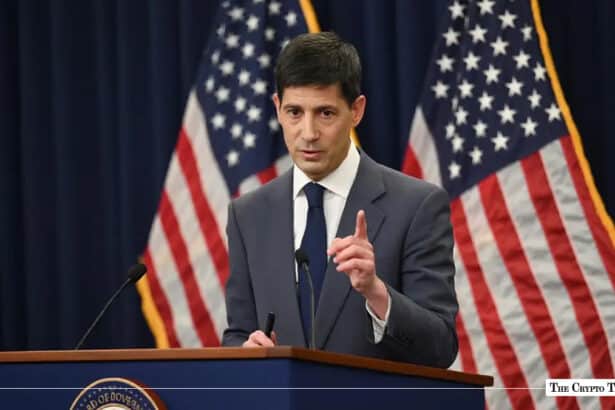
CFTC Chairman Michael Selig said the agency is prepared to keep fighting states over prediction markets, warning that the legal battle over event contracts could ultimately reach the U.S. Supreme Court.
Speaking at Consensus Miami 2026, Selig defended the CFTC’s authority over event-based contracts, including sports and political markets, and said state gaming regulators are trying to undermine federal law by treating federally regulated derivatives like gambling products.
“We expect these matters to go up to the Supreme Court,” Selig said during the fireside chat.
The comments come as the CFTC has sued several states, including Arizona, Connecticut, Illinois and New York, over state-level actions against CFTC-registered contract markets. The agency has argued that Congress created a national framework for derivatives markets and did not leave commodity derivatives regulation to a state-by-state gambling regime.
Prediction Markets Are Not Casino Bets, Selig Says
Selig said the legal fight comes down to the difference between a regulated event contract and a casino-style wager.
According to Selig, event contracts trade on federally regulated exchanges, use order books, and clear through clearinghouses that stand between buyers and sellers. That structure, he said, makes them financial instruments rather than entertainment bets.
“When you walk into a casino, you give money to a bookie. The bookie is taking the other side of that,” Selig said. “You’re just placing a bet.”
He argued that a casino customer cannot freely enter and exit a position on an order book, while event-contract traders can sell their positions before settlement as market odds change.
“What we’re looking at is parallel regulatory regimes for entertainment and financial instruments,” Selig said.
CFTC Says States Are Trying to Nullify Federal Law
Selig said state gaming commissions are trying to protect local gambling regimes by going after federally registered exchanges.
“My concern when I saw these lawsuits with state gaming commissions, like the state of Nevada and others, bringing actions against our registrants, was that you would be able to potentially walk into a casino and engage in derivatives transactions without any investor protections,” he said.
The CFTC chair said the agency has already sued “five or six states” and will continue filing lawsuits when it sees state actions interfering with federal authority.
“We’ll continue to bring lawsuits whenever we see these impingements on our federal authority,” Selig said.
Selig Says Crypto Rules Are Becoming Harder to Undo
Selig also used the discussion to frame the SEC-CFTC crypto taxonomy as a major shift in U.S. digital asset regulation.
The SEC and CFTC’s March 17 guidance laid out five categories for digital assets: digital commodities, digital collectibles, digital tools, stablecoins and digital securities. The CFTC said it would administer the Commodity Exchange Act consistent with the SEC’s interpretation, while noting that some non-security crypto assets may still qualify as commodities under the CEA.
“For so long, our participants have been afraid to build here in the United States, and part of the reason for that has been the lack of clarity,” Selig said.
He said joint rulemaking between the SEC and CFTC gives the industry more certainty because both agencies would have to reverse course to undo the framework.
“As you move towards rulemaking, it’s a bit more lasting, especially when it’s joint,” Selig said. “It’s much harder to get multiple agencies to undo something.”
Wallet Developers Get Relief From Broker Rules
Selig also pointed to the CFTC’s no-action position for Phantom Technologies as an early example of the agency’s more developer-friendly approach.
The CFTC staff issued a no-action position on March 17 related to Phantom’s self-custodial wallet software and its proposed ability to help users trade with registered futures commission merchants, introducing brokers and designated contract markets.
“For so long, these software developers have been concerned about being regulated as brokers,” Selig said.
He said the Phantom letter clarified that self-custodial wallet software developers meeting certain conditions would not be required to register as CFTC brokers.
“We want to get some clear guidance out there to help these firms start to develop and offer their software in the U.S.,” he said.
Selig added that self-custodial wallets could eventually connect directly to regulated derivatives exchanges, allowing users to trade without keeping assets on a custodial platform.
“We believe that’s going to unlock a lot of really interesting DeFi activity here in the U.S.,” he said.
CFTC Turns to AI for Market Surveillance
Selig said the agency is also using AI and automation to review filings, trade data and suspicious activity across markets.
He said exchanges remain the first line of defense because many event contracts are self-certified. Still, the CFTC is leaning into AI tools to help review products and monitor market behavior.
“We can’t live in this world of the past,” Selig said. “We can’t be Luddites and avoid technologies that are proving out to be really game-changing for the private sector.”
He added that AI will not replace human oversight, noting that agency staff, quants, exchanges and market participants still help flag unusual trading activity.
Selig Says One-Member CFTC Will Keep Moving
Selig also addressed concerns that he is currently the only member of the five-member commission.
The CFTC lists Selig as the agency’s 16th chairman after he was sworn in on December 22, 2025, following Senate confirmation.
Selig said the statute does not require a quorum and allows him to operate as chairman while voting on behalf of the commission.
“We can’t slow down,” Selig said. “We have to continue to push forward on the mission.”
He said the administration has already ended “regulation by enforcement,” passed the GENIUS Act into law, and is now moving toward broader market structure legislation through the CLARITY Act. President Donald Trump signed the GENIUS Act into law on July 18, 2025, creating a federal framework for payment stablecoins.
“We’re on the cusp of getting clarity on the legislative front with the CLARITY Act,” Selig said. “This is really a key time, and I’m not going to slow down.”
Also Read: Clarity Act on Fast Track? Senator Moreno Sets July 4 Deadline