
Key Highlights
- Robinhood stock fell 5.78% to $90.60 after touching an intraday low of $88.21.
- Investors appear to be reducing exposure before Robinhood reports its second-quarter results on July 29.
- A broader Nasdaq sell-off, falling Bitcoin prices and uncertainty surrounding the Federal Reserve meeting added to the pressure.
Robinhood Markets Inc. (NASDAQ: HOOD) shares dropped sharply on Tuesday, falling 5.78% to $90.60 by 10:39 a.m. ET.
The stock opened at $92.66 before falling as low as $88.21, representing a decline of nearly 8% from Monday’s closing price of $95.65.
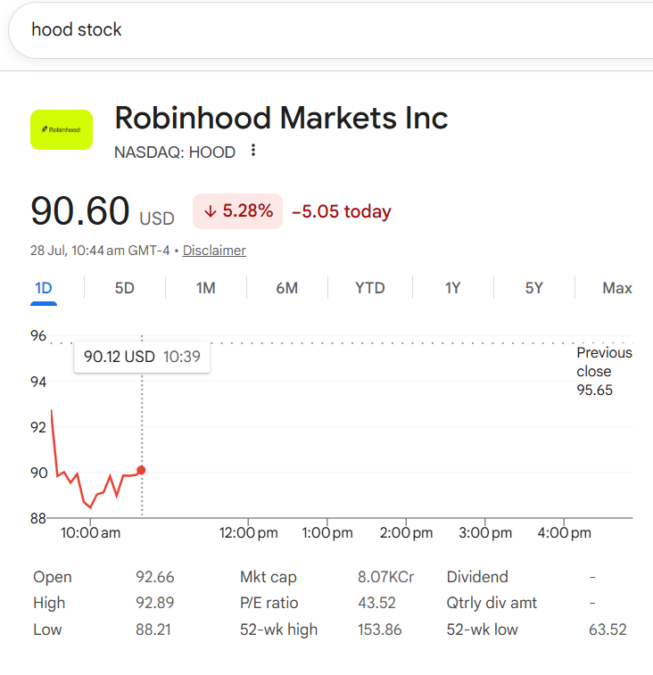
The sell-off does not appear to be linked to a single new announcement from Robinhood. Instead, investors are dealing with a combination of earnings uncertainty, weakness across technology stocks and declining cryptocurrency prices.
Robinhood Earnings Raise Expectations and Risks
The most immediate reason behind the decline is Robinhood’s upcoming second-quarter earnings report.
Robinhood will release its Q2 2026 financial results after the market closes on Wednesday, July 29. CEO Vlad Tenev and CFO Shiv Verma will discuss the results during an earnings call at 5:00 p.m. ET.
Wall Street expects Robinhood’s revenue to grow approximately 29% from the previous year, while earnings are projected at about $0.42 per share. However, the stock’s elevated valuation means even otherwise strong results could disappoint investors if major business segments fail to meet expectations.
Robinhood previously missed revenue and earnings estimates during the first quarter as cryptocurrency transaction revenue declined 47% year-over-year to $134 million. That result has made crypto trading activity one of the most closely watched figures heading into the Q2 report.
Tuesday’s decline may therefore reflect investors taking profits or reducing positions before an earnings announcement that could produce another large price swing.
Nasdaq Sell-Off Pulls HOOD Lower
Robinhood’s decline also came during a broader sell-off across technology and other high-growth companies.
The Nasdaq Composite fell more than 1% as semiconductor stocks declined amid concerns about expensive artificial intelligence investments, increasing competition from Chinese chipmakers and uncertainty surrounding future corporate earnings. The semiconductor index dropped approximately 4%.
Although Robinhood operates as a financial services company, its shares frequently trade like a high-growth technology stock. Its relatively high valuation and exposure to retail trading activity can cause HOOD to move more aggressively whenever investors reduce risk.
The fact that several other growth and crypto-related stocks declined at the same time suggests Robinhood’s fall was partly connected to the wider market rather than a new problem limited to the company.
Bitcoin Weakness Adds Pressure
Weakness in the cryptocurrency market provided another negative signal for Robinhood investors.
Bitcoin declined approximately 2.1% to around $63,191 during Tuesday’s session, while Coinbase stock fell nearly 2.8%. Robinhood shares dropped more than both, reflecting the additional uncertainty surrounding Wednesday’s earnings report.
Crypto trading remains an important source of transaction revenue for Robinhood. Falling cryptocurrency prices do not automatically mean lower revenue, as volatility can sometimes increase trading volumes, but prolonged weakness can reduce retail participation and transaction activity.
That concern is particularly relevant after Robinhood App crypto volume remained 50% below the previous year in May, despite increasing 9% from April.
Federal Reserve Decision Creates More Uncertainty
Robinhood will report earnings on the same day that the Federal Reserve announces its latest interest-rate decision.
The central bank began its two-day policy meeting on Tuesday. While an immediate rate increase is not the base-case expectation, investors remain concerned that inflation and energy prices could produce a more hawkish message about future interest rates.
Higher interest-rate expectations typically place pressure on richly valued growth stocks because investors apply a higher discount rate to their expected future earnings.
With Robinhood trading at a price-to-earnings ratio of approximately 43.6, the stock has less protection against disappointing results or cautious management guidance.
What Should Investors Watch Next?
Robinhood’s earnings report will determine whether Tuesday’s decline was simply pre-earnings caution or the beginning of a deeper reassessment of the company’s growth outlook.
Investors will focus on crypto transaction revenue, prediction-market volumes, net deposits, funded customers and total platform assets. Management’s outlook for the remainder of 2026 will be equally important.
The company is also expected to recognise approximately $28 million in second-quarter restructuring costs connected to its decision to reduce its workforce by about 10%, or roughly 290 positions.
Until the Federal Reserve decision and Robinhood’s earnings are released, HOOD stock could remain volatile around the $88 to $96 range established during Tuesday’s trading session.
Also Read: Bitmine Stock (BMNR) Jumps 13% as Ethereum Holdings Near 5% Goal