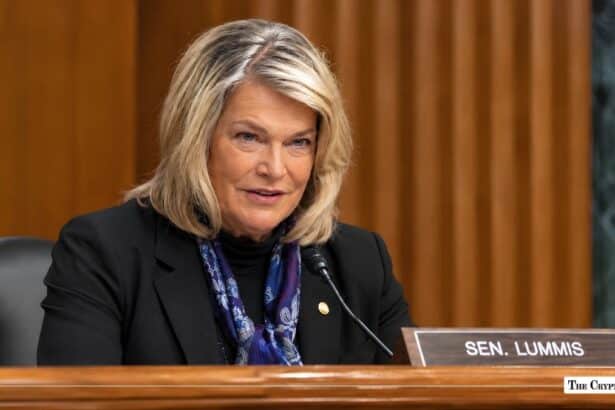
Senate Banking Digital Assets Subcommittee Chair Cynthia Lummis (R-Wyoming), Senate Agriculture Committee Chairman John Boozman (R-Arkansas), and Senate Banking Committee Chairman Tim Scott (R-South Carolina) released a final draft of the Digital Asset Market Clarity Act late Sunday (Sept. 13-14), commonly referred to as the CLARITY Act, late Sunday, hours before the chamber’s first procedural vote on the crypto market-structure bill.
The substitute, posted on Lummis’s Senate site with supporting fact sheets, was framed by the three sponsors as their “last, best and final” offer to Democrats. According to the official release, the text incorporates 126 substantive changes requested by Democratic negotiators over more than a year of talks and will be offered as an amendment like a substitute to H.R. 3633, the House-numbered version of the bill, if cloture is invoked on Tuesday afternoon.
The Senate is scheduled to vote at 2:15 p.m. Eastern Time (ET) on Tuesday, September 15, on cloture on the motion to proceed to H.R. 3633. Cloture requires 60 votes to end debate. Republicans hold 53 seats in the chamber, which means the bill needs support from at least seven Democratic or independent senators if the Republican caucus stays united. A failed vote would likely push comprehensive market-structure legislation past the 2026 midterm elections.
Read: Can the Senate Pass the CLARITY Act on September 15? Here’s the Vote Math
Ethics language draws on Tillis-Gallego framework
The most consequential change in the Sunday text concerns the ethics division, which had been the primary obstacle to Democratic support through the summer. According to former Fox Business journalist Eleanor Terrett, a senior Republican aide, speaking on condition of anonymity, told reporters the revised language covers roughly 80% of the counterproposal that Sens. Thom Tillis (R-North Carolina) and Ruben Gallego (D-Arizona) sent to the White House in late July.
Under the revised text, covered federal officials and their spouses would be required to divest what the sponsors described as “substantial” or “significant” crypto-related financial interests, or place them in a qualified blind trust. State attorneys general (AGs) would gain a role in enforcing the ethics provisions, a concession the White House had previously resisted.
In a statement accompanying the release, Lummis said President Donald Trump “voluntarily agreed to unprecedented ethics restrictions, holding every federally elected official, judge, and their spouses to some of the toughest ethics restrictions in U.S. history.” The Crypto Times previously reported that Trump met with advisers on the ethics file on Friday, September 12, two days before the release of the final substitute. Democratic reaction to the new Sunday text had not been issued as of early Monday.
Blockchain Regulatory Certainty Act narrowed to civil enforcement
The Blockchain Regulatory Certainty Act (BRCA), a developer-liability provision designed to shield non-custodial software developers from being treated as regulated money transmitters, was narrowed in the Sunday text. Officials said its protections now apply to Bank Secrecy Act (BSA) civil enforcement and a civil safe harbor for non-custodial developers.
Language that would have extended the same protections to criminal cases, including prosecutions under 18 U.S.C. §1960, the federal statute covering unlicensed money-transmitting businesses, was removed. The change addresses long-standing concerns from prosecutors’ associations that the earlier draft could interfere with active criminal investigations.
Treasury circuit breaker on stablecoin flight
On payment stablecoins, the draft adds a “circuit breaker” authority first floated by Senator Tillis in July. The Treasury Secretary, currently Scott Bessent, would be empowered to intervene if there is evidence of widespread deposit flight from community banks into stablecoins. The provision is designed as a backstop for community banks, farmers and small businesses, and is intended to answer concerns raised by regional banking associations about deposit disintermediation.
Agriculture title tightens vertical integration rules
The Agriculture Committee title, drawn from the Digital Commodity Intermediaries Act (DCIA), received tighter guardrails on vertical integration, including new limits on affiliate trading and on conflicts of interest among digital commodity exchanges, brokers and dealers.
The text also clarifies that state consumer-protection laws continue to apply and that developer protections do not create exemptions from derivatives laws or affect prediction markets.
Sponsors’ statements
“After a year of intense daily bipartisan negotiations, this bill is ready,” Lummis said in the release. “Democrats got what they wanted; now they need to take yes for an answer.”
Boozman said, “We cannot afford to wait any longer. This legislation is the result of more than a year of negotiations with our colleagues and conversations with stakeholders to get the details right.”
Scott added, “This final text further empowers law enforcement and gives the Treasury Secretary the tools to protect community banks, farmers, and rural Americans.”
Background and outlook
The House of Representatives passed its version of the CLARITY Act on July 17, 2025, by a 294-134 vote, with 78 Democrats joining Republicans in support. The Senate Banking Committee advanced the Senate companion 15-9 on May 14, 2026.
Earlier drafts released in September had added Commodity Futures Trading Commission (CFTC) registration requirements for so-called “decentralized-in-name-only” decentralized finance (DeFi) protocols and limited the DeFi provisions to spot and cash digital commodity transactions, as The Crypto Times reported on September 11, but had left the ethics and stablecoin yield language largely unchanged. The Sunday text is the first version to include the revised ethics package and the Treasury circuit breaker.
Major financial institutions, including BlackRock, Fidelity, Franklin Templeton, Goldman Sachs, Charles Schwab and SoFi, along with law enforcement organizations such as the National Fraternal Order of Police and the National Organization of Black Law Enforcement Executives, endorsed earlier versions of the measure. Some Democratic senators and prosecutors’ associations have continued to press for tighter developer-liability language.
If Tuesday’s cloture motion fails, sponsors have said, another attempt in this Congress becomes significantly harder given the compressed pre-midterm calendar. Coinbase Chief Financial Officer (CFO) Alesia Haas said in a Sept. 11 interview at Goldman Sachs’ Communacopia & Tech Conference that the exchange has a fallback plan if the CLARITY Act does not clear the Senate this session.
“There was always three paths to getting Clarity,” Haas said. “There was Congress, there were the agencies themselves, or there was the court system.” She added: “If Clarity doesn’t pass by Congress, we believe that we have a path via the SEC and the CFTC. Both Chair Selig [CFTC] and Atkins [SEC] have been incredibly innovative in trying to drive forward change in rulemaking at the agency level. And so we believe we’ll be able to offer new products and services via the agencies.” Coinbase President and COO Emilie Choi said a legislative miss would not force the company to shrink its product plans.
Also Read: CLARITY Act: Warren Davidson Pushes to Strip Section 305 Before Tuesday’s Senate Vote