Key Highlights
- Ohio and 38 other states, plus Washington, D.C., filed an amicus brief supporting New Jersey’s petition in the Kalshi case.
- The states argue that the Commodity Exchange Act does not preempt state sports-gambling laws.
- The filing points to different rulings from the Third, Ninth and Sixth Circuits over Kalshi’s sports contracts.
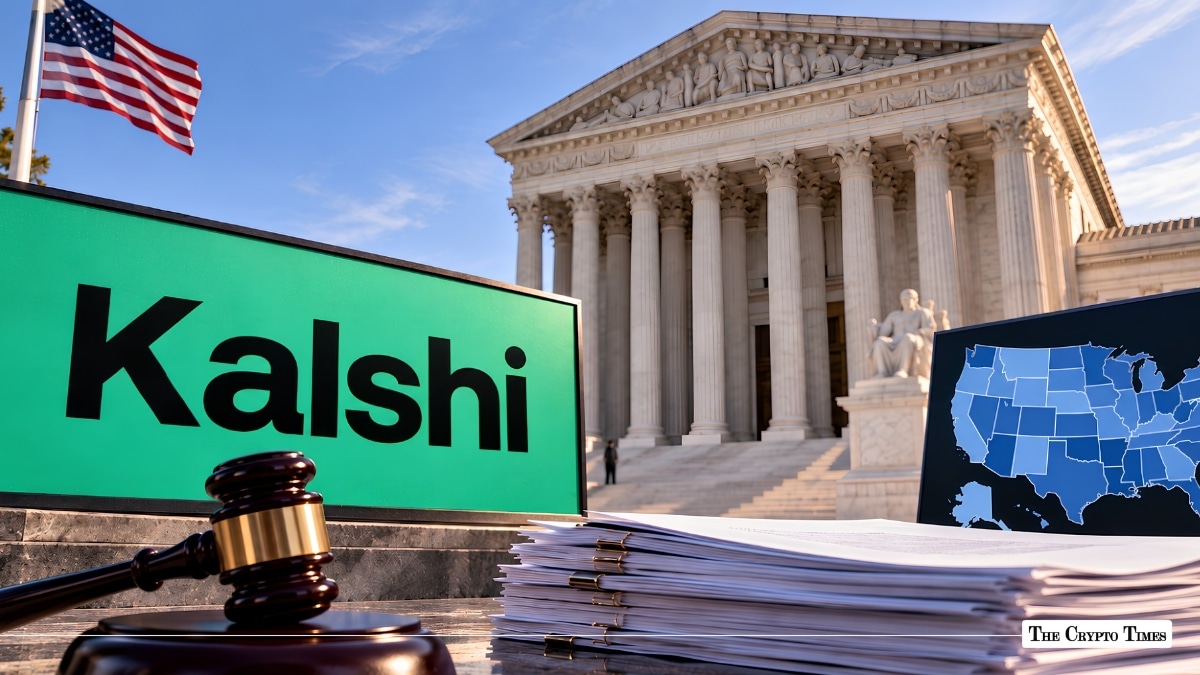
Ohio and 38 other states, along with Washington, D.C., have asked the U.S. Supreme Court to review whether federal law prevents states from regulating sports contracts offered by prediction-market platforms such as Kalshi.
According to the October 7 filing, the states submitted an amicus brief in Flaherty v. KalshiEX, LLC., supporting New Jersey’s petition for review. The case is listed as No. 26-299.
At the center of the dispute is whether sports-event contracts offered by federally regulated prediction markets qualify as “swaps” under the Commodity Exchange Act (CEA) and whether the law prevents states from enforcing their gambling regulations against those contracts.
The filing comes as federal appeals courts have reached different conclusions on the contracts and the scope of federal preemption.
States point to split over Kalshi sports contracts
The states’ brief highlights rulings from the Third, Ninth and Sixth Circuits.
The Third Circuit ruled in favor of Kalshi, holding that its sports-event contracts qualify as swaps and that the CEA’s exclusive-jurisdiction provision preempts New Jersey’s gambling laws.
The Ninth Circuit reached a different conclusion, holding that Kalshi’s sports-event contracts were not swaps under the CEA and that federal law did not preempt Nevada’s gaming regulations.
The Sixth Circuit also concluded that the CEA does not preempt state gambling laws, finding that the contracts were not swaps and that the CEA’s exclusive-jurisdiction provision did not expressly or impliedly preempt state gambling laws.
“The circuits are fractured,” the states wrote.
The brief says related cases remain pending in the Second, Fourth, Seventh, Eighth and Tenth Circuits, as well as the Massachusetts Supreme Judicial Court.
States say gambling regulation is traditionally their role
The states’ central argument is that gambling regulation has historically fallen within state authority.
The brief cites the Supreme Court’s 2018 decision in Murphy v. NCAA, which addressed states’ authority to regulate sports gambling.
According to the filing, prediction markets cannot avoid state gambling laws simply by classifying sports contracts as federally regulated derivatives.
“The prediction markets are wrong,” the brief states.
The filing argues that Congress would need to clearly authorize the CEA to displace states’ longstanding authority over gambling.
States warn about consumer protections
The brief says state gambling laws include minimum-age requirements, exclusion lists, spending limits and other consumer protections.
The states argue that treating prediction-market sports contracts as exclusively federally regulated derivatives could make those protections difficult or impossible to enforce.
The filing also points to the role of state regulators in addressing gambling-related risks.
CFTC supports broader federal preemption
According to the states’ brief, the CFTC has increasingly supported the position that federal law preempts state gambling regulations.
The states say the agency has filed amicus briefs in prediction-market cases and sued several states over their attempts to enforce sports-gambling laws.
The brief lists CFTC actions involving Arizona, Connecticut, Illinois, Kentucky, Minnesota, New Mexico, New York, Rhode Island and Wisconsin.
The states also point to the CFTC’s June 2026 proposed rulemaking on prediction markets, which discusses federal preemption and a framework for sports-event contracts on federally regulated markets.
The states say 44 states submitted comments opposing the CFTC’s approach, arguing that the CEA does not give the agency authority to preempt state gambling laws.
New Jersey previously asked Supreme Court to review Kalshi
The states’ filing follows New Jersey’s September 2 petition asking the Supreme Court to decide whether Kalshi can offer sports-related contracts without complying with state gambling laws.
The petition was docketed as No. 26-299 on September 8. The Supreme Court docket shows that Kalshi’s response deadline has been extended to November 9, 2026.
New Jersey’s petition followed the April 2026 Third Circuit ruling that found Kalshi’s sports-event contracts likely qualify as swaps and that federal law preempts the state’s gambling regulations.
The Supreme Court has not yet agreed to hear the case.
New York case shows Federal-State dispute
The states also cite New York as an example of the conflict between state and federal regulators.
New York’s attorney general filed a state enforcement action against Kalshi, alleging that the company was operating an illegal gambling operation.
The CFTC later issued an order directing Kalshi to continue exercising its designated contract market functions despite the New York litigation.
The states argue that the competing actions show the uncertainty over federal and state authority.
More prediction-market cases are pending
The dispute extends beyond New Jersey.
The states’ brief lists cases involving Kalshi and other prediction-market operators, including Coinbase, Crypto.com Derivatives and Robinhood Derivatives.
Other gaming regulators and organizations have separately urged the Supreme Court to review the New Jersey case. The International Association of Gaming Regulators and North American Gaming Regulators Association filed an amicus brief on October 2 supporting review.
The Supreme Court docket currently shows several amicus filings in No. 26-299 as the case awaits Kalshi’s response.
What the States want from the Supreme Court
The states are asking the Supreme Court to grant New Jersey’s petition for certiorari and resolve whether the CEA prevents states from applying their gambling laws to sports contracts offered by federally regulated prediction markets.
The filing presents the states’ position in support of Supreme Court review. The Court has not yet decided whether to take up the case.
Also Read: VolMEX Seeks Guidance on Crypto-Based Options from SEC