
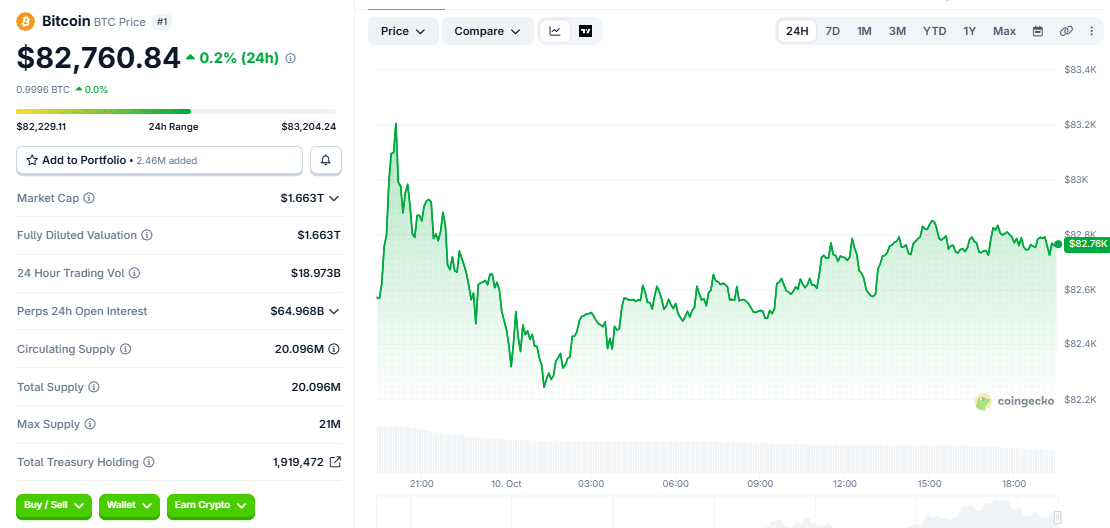
Bitcoin traded near $82,760 on Saturday, October 10, after a volatile week marked by heavy crypto liquidations, U.S. spot Bitcoin ETF outflows and expectations of further Federal Reserve tightening. The relative price stability comes as investigators examine more than $86 million in reported crypto losses linked to devices purchased from Ledger reseller CryptoBilis. The estimated losses have not been independently confirmed, and there is not enough evidence to conclude that the incident had no effect on Bitcoin’s price.
According to CoinGecko data, Bitcoin was trading at approximately $82,760.84 at 14:01 UTC, up around 0.2% over 24 hours. Its price ranged between $82,229 and $83,204 during that period. Bitcoin’s 24-hour trading volume stood at approximately $18.97 billion, while its market capitalization was around $1.663 trillion. Perpetual-futures open interest was approximately $64.97 billion, down from roughly $69 billion earlier in the week, according to the figures available at the time of the snapshot.
The decline in open interest is consistent with a reduction in outstanding derivatives exposure, although it does not establish how much of the change resulted directly from liquidations. Bitcoin’s circulating supply stood at approximately 20.096 million BTC, against its maximum supply of 21 million. At the reported price, BTC remained around 34% below its all-time high of approximately $126,080 recorded in October 2025.
The week that drove crypto liquidations
Bitcoin’s Saturday trading range followed a period of significant liquidations across the crypto market. Approximately $1.12 billion in positions were liquidated in the 24 hours leading into October 8, including around $1.04 billion in long positions, according to CoinGlass data. The Crypto Times previously reported the liquidations as Bitcoin tested the $82,000 level amid ETF outflows.
The latest available CoinGlass figures showed approximately $82.37 million in liquidations across 52,702 traders over a subsequent 24-hour period. Long positions accounted for 49.2% of the total and short positions for 50.8%. Bitcoin-related liquidations were approximately $7.39 million.
The lower liquidation total indicates that forced position closures had eased compared with the earlier period. However, a single 24-hour snapshot does not establish whether selling pressure has ended or whether another round of liquidations will follow.
Bitcoin ETF flows turn positive after outflows
U.S. spot Bitcoin exchange-traded funds also showed a change in daily flows following two sessions of substantial outflows.
According to SoSoValue’s spot Bitcoin ETF data, the funds recorded net outflows of approximately $487.07 million on October 7 and $244.13 million on October 8. Flows then turned positive, with a reported net inflow of $21.13 million on October 9.
The positive session followed two days of redemptions, but it is not sufficient on its own to establish a sustained recovery in institutional demand. The figures available at the time also put cumulative net inflows since the funds launched at approximately $57.11 billion, with total net assets near $105.84 billion.
ETF flows remain one indicator of demand for regulated Bitcoin investment products. Their effect on spot prices depends on wider market conditions, including other buying and selling activity.
Fed minutes add to the macroeconomic backdrop
The Federal Reserve’s September meeting minutes, released on October 7, showed that most policymakers considered another interest-rate increase by the end of 2026 likely to be appropriate.
The Fed raised its target federal funds rate to 3.75%–4.00% at the September meeting. The minutes recorded policymakers’ views on inflation and the policy outlook but did not commit the central bank to another increase at its next meeting on October 27–28.
Higher interest rates can weigh on risk-sensitive assets by increasing the relative appeal of interest-bearing investments and tightening financial conditions. However, the Fed’s outlook is only one factor affecting Bitcoin, and the week’s price movement cannot be attributed to monetary policy alone.
The market also navigated a reported $2.16 billion Bitcoin and Ether options expiry on October 9. Bitcoin traded below the cited $84,000 max-pain level. Max pain is a reference point based on options positioning, not a level that necessarily determines where the asset will trade.
Did the Ledger breach move the market?
The week’s other big story was a security scare, and it is worth addressing directly because market watchers on social media are asking: the answer is that it had no discernible effect on Bitcoin’s price. On October 9, reports emerged that users of hardware-wallet maker Ledger had been drained of funds, with on-chain investigators estimating losses of more than $86 million, and some figures reaching as high as $92.9 million, across about 311 wallets spanning Bitcoin, Ethereum, TRON, BNB Chain and Polygon. Ledger is probing a reseller after the reported losses.
Crucially, the incident appears to trace to CryptoBilis, a third-party Ledger reseller and official distributor in parts of Southeast Asia, not to Ledger’s own core systems. Ledger has asked the reseller to pause all sales and shipments while it investigates, and the cause remains unconfirmed; Binance’s Changpeng Zhao suggested a localized supply-chain issue with a single vendor, while cautioning that this was an assessment rather than a finding. On the available evidence, there is no indication that Ledger’s core infrastructure was compromised.
For all the alarm it has caused hardware-wallet owners, and it is a serious reminder to buy devices only from trusted sources and never trust pre-configured or tampered hardware, an $86-million drain across a few hundred wallets is simply not the kind of event that moves a $1.66-trillion asset. It is a targeted security and supply-chain story, not a source of market-wide selling pressure or a macro catalyst. Bitcoin’s flat, slightly positive print on the day underlines the point: the breach matters enormously to those affected, and barely at all to the price.
What Bitcoin traders are watching next
Bitcoin’s near-term price action will depend on whether it can maintain its position in the low-$80,000 range and recover levels seen earlier in the week.
The $80,000 area remains a reference point for traders watching downside support, while $84,000 is a level to monitor following the latest options expiry. A move toward $87,000 would bring a higher area of recent trading resistance back into focus, although none of these levels guarantees a particular price direction.
Market participants will also monitor U.S. spot Bitcoin ETF flows after the October 9 inflow, changes in futures open interest and the Federal Reserve’s October 27–28 meeting. With open interest still near $65 billion, derivatives positioning remains relevant to potential volatility. These indicators provide context for market conditions, not a reliable forecast of Bitcoin’s next move.
Also Read: AI Unlikely to Break Bitcoin Signatures Anytime Soon, Ledger CTO Says